What “working” should mean
A spinning motor is not the same as effective exhaust. A complete test asks five separate questions:
- Does the fan start and run without electrical warning signs or abnormal mechanical noise?
- Does room air move into the grille?
- Does that air leave through a dedicated outdoor termination?
- Can replacement air enter the bathroom while the fan runs?
- Is the delivered airflow adequate for the intended design and does the room recover after bathing?
The U.S. Department of Energy's Building America Solution Center demonstrates bath-fan airflow testing with a flow hood and an anemometer. ENERGY STAR also distinguishes tested product ratings and installed fan performance. Those are important limits: a household observation can reveal a failure, but it does not certify a CFM value.
Stop before testing if the area is unsafe
If the fan is wet or has an electrical fault, switch off the appropriate circuit only when you can do so safely and arrange qualified service. If the concern is water dripping through the unit, use the bathroom fan water-drip safety checklist instead of running a test.
A safe six-step fan test
1. Start with a dry visual and sound check
From the floor, look for a grille packed with dust, a cover hanging loose, stains around the housing or an obvious obstruction. Turn the fan on using its normal control. Note whether it starts promptly and whether the sound is steady.
Rattling may come from a loose cover; scraping or grinding can indicate a mechanical problem. A very loud motor does not prove strong airflow, and a quiet fan is not necessarily weak. If the grille is visibly blocked, follow the model instructions and the safe bathroom fan cleaning guide before comparing performance.
2. Screen for inward airflow at the grille
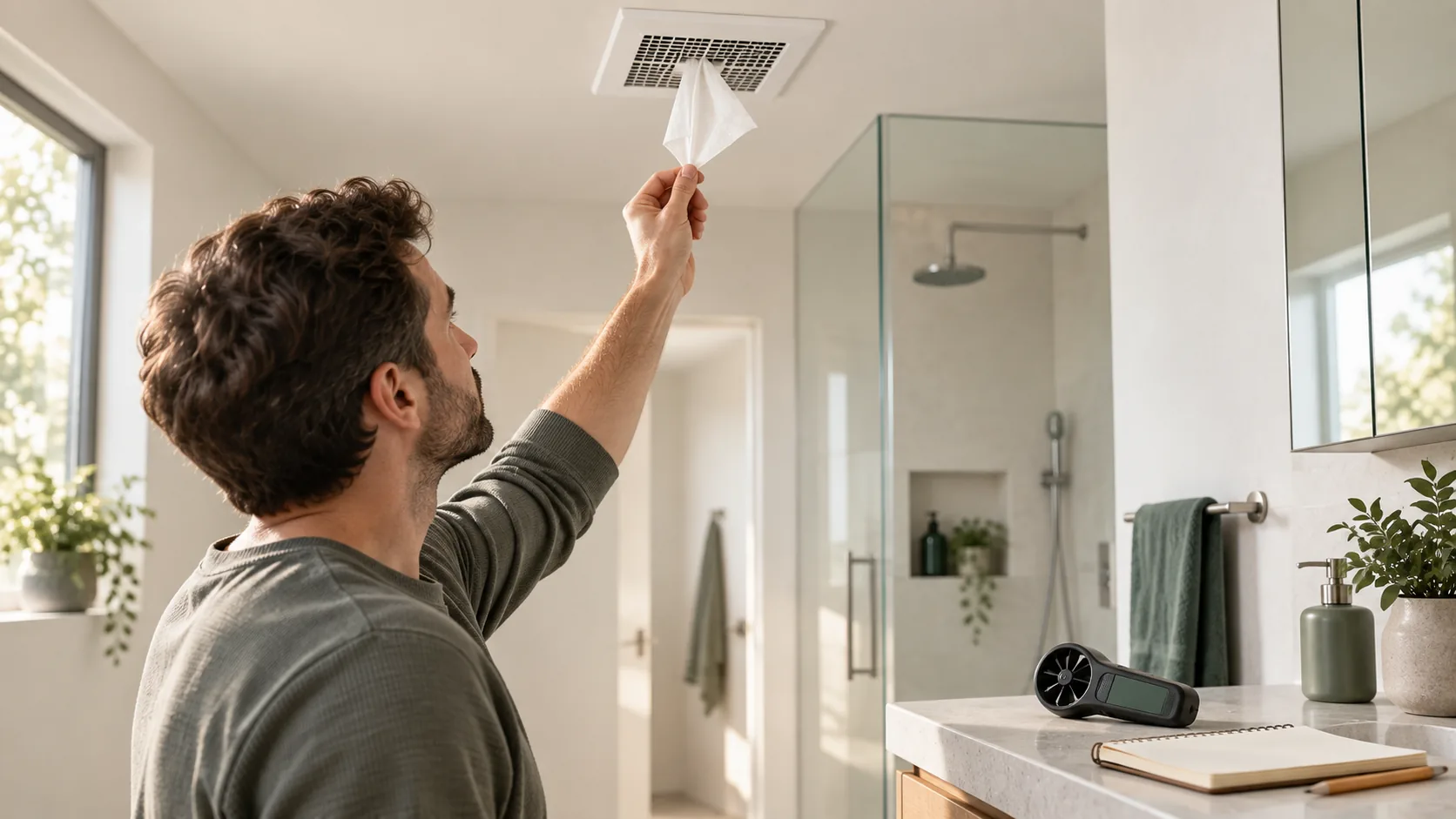
With the floor and your hands dry, hold one corner of a single lightweight tissue or a narrow strip of toilet paper and bring the flat portion close to the grille. Keep hold of it so it cannot be pulled into the fan. Do not poke paper, fingers or tools through the grille.
- It pulls toward or rests against the grille: the fan is drawing some room air.
- It barely moves or falls away: intake may be weak, but the cause is not yet known.
- Air seems to blow into the room: switch the fan off and arrange inspection; the air path or fan operation needs investigation.
This is a directional clue only. Paper weight, grille shape and local air currents affect the result. The test cannot tell you whether the fan delivers 30, 50 or 100 CFM, and it cannot prove that the duct reaches outdoors.
3. Compare the intended replacement-air path
Run the tissue screen first with the bathroom door in its normal operating position. Then open the door slightly and repeat under otherwise similar conditions. If suction becomes noticeably stronger only when the door is open, the room may lack an adequate intended path for replacement air.
Do not cut a door, enlarge a gap, add a grille or change a fire-rated assembly based on this observation. Door clearances and transfer paths can be part of a wider ventilation, fire-safety or pressure design. Ask an appropriate building or HVAC professional to assess the path when the difference is large.
4. Confirm discharge at the exterior termination
A fan should send bathroom air outdoors, not into an attic, wall cavity, crawlspace or space between floors. If the exterior wall or roof termination is safely visible from the ground, have one person switch the fan while another observes the outlet. A damper may open and airflow may be noticeable, depending on the cap and conditions.
Do not climb onto a roof, lean from a window or put fingers into an exterior cap. Wind can move a flap even when the fan is off, while paint, lint, nests or damage can prevent normal opening. If the outlet cannot be identified safely, follow the bathroom fan vent-route checklist or arrange an inspection.
5. Check the bathroom's response during a repeatable shower
Use the same shower duration, water-temperature range, fan setting, door position and measurement location for each comparison. Record relative humidity before bathing, shortly afterward and at regular intervals while the fan runs. Also note how long mirrors, walls and other surfaces remain visibly wet.
A clear downward humidity trend and steady surface drying support that the ventilation routine is helping. Slow recovery does not prove the motor has failed: the moisture load, duct restriction, fan size, replacement air, outdoor conditions, cold surfaces or another moisture source can all matter. The bathroom humidity measurement guide explains how to run a consistent recovery check.
6. Measure delivered airflow when the answer matters
For commissioning, code verification, a new installation or persistent moisture, use an appropriate measured-airflow test. A flow hood designed for exhaust grilles is one direct method. An anemometer can also be used with a suitable test setup and calculation, but a spot air-speed reading by itself is not a reliable CFM result.
Compare the measured airflow with the requirement that applies to the project—not simply with a number remembered from another bathroom. The fan's role, local requirements, design documents and manufacturer instructions can differ. If you are selecting or replacing equipment, the bathroom exhaust fan sizing guide explains rated CFM, duct resistance and installed performance.
What the test result may mean
| Result | Useful next step |
|---|---|
| Fan does not start | Check the normal control only; if the breaker is tripped, repeatedly trips or the circuit is uncertain, stop and use a qualified electrician. |
| Motor runs but there is little intake | Check for accessible dust, compare the door position and arrange duct, damper or airflow inspection if weakness remains. |
| Intake is present but no outdoor discharge is found | Do not assume the route is complete. Trace the duct safely or use an appropriate contractor. |
| Intake improves greatly with the door ajar | Have the intended replacement-air path assessed before altering the door or wall. |
| Airflow seems present but humidity stays elevated | Measure delivered airflow and review fan runtime, moisture load, cold surfaces and other sources. |
| Fan rattles, grinds, smells hot or trips a breaker | Stop use and arrange service rather than continuing the test. |
Tests to avoid
- Do not use a flame, candle, incense or smoke: these add combustion products, can create a fire risk and may trigger alarms. They are unnecessary for a basic bathroom check.
- Do not release paper into the grille: keep hold of the tissue and keep objects outside the cover.
- Do not block the grille: a long blockage is not a valid performance test and can stress the fan.
- Do not remove the cover with power on: internal inspection and cleaning require the model-specific safety process.
- Do not treat steam disappearance as a CFM meter: temperature and surface conditions change what you can see.
- Do not use roof access as a shortcut: an inaccessible termination should be checked by someone equipped for that work.
Before replacing the fan
A weak result can come from the fan, but it can also come from a dust-loaded grille, closed damper, disconnected or crushed duct, excessive bends, unsuitable duct size, restrictive exterior cap or inadequate replacement-air path. Test the complete path before buying a larger motor.
If the system works but the bathroom remains damp, check how long the fan runs after a shower. If the fan needs replacement, compare certified airflow, duct compatibility and sound rather than choosing by headline CFM alone.
Frequently asked questions
Does the tissue test prove a bathroom fan is working?
It proves only that some air is moving toward the grille at that moment. It does not confirm delivered CFM, a complete duct or outdoor discharge. Use it as a screening check, not a pass-or-fail measurement.
Can I test a bathroom fan without removing the cover?
Yes. The intake screen, replacement-air comparison, safe exterior observation and humidity-recovery check are all performed with the grille in place. Removing the grille is unnecessary for this test.
Why does the fan pull better with the door open?
The room may not have enough intended replacement air with the door closed. A large difference is evidence to assess the air path, not permission to alter a door or fire-rated assembly without checking the design and local requirements.
What is the most reliable bathroom fan airflow test?
An appropriate calibrated measurement at the exhaust grille, such as a correctly used flow hood, gives a delivered-airflow result that can be compared with the applicable design target. Informal tissue and steam checks do not produce CFM.
What if the fan passes the tissue test but the bathroom stays wet?
Check outdoor discharge, measured airflow, runtime, replacement air, shower moisture load and other moisture sources. Surface temperature and room-wide humidity also affect condensation, so one intake clue cannot explain the whole result.
Bottom line
Test the bathroom fan as a complete air path. Confirm safe operation, inward flow at the grille, discharge outdoors, available replacement air and a repeatable improvement in room recovery. Use informal checks to locate the weak stage, and use calibrated airflow measurement when you need to prove performance.