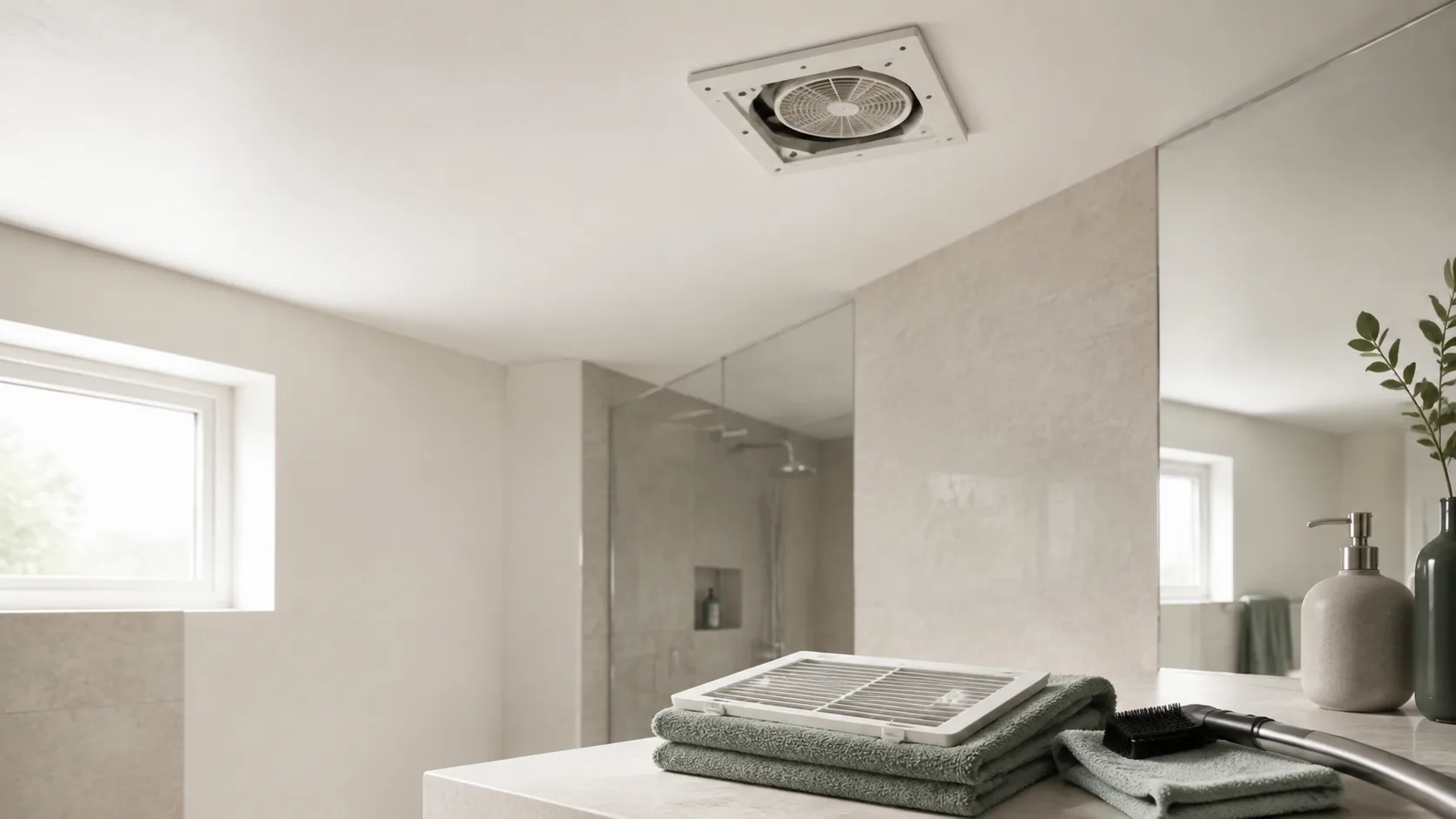
Why clean a bathroom exhaust fan?
A bathroom fan has to pull room air through its grille before sending it through the duct. Dust and lint can collect on that air path. The U.S. Department of Energy's Building America Solution Center says buildup can inhibit performance, increase noise and add wear to the motor. Its maintenance guidance recommends cleaning the cover and accessible fan parts rather than assuming that motor sound means useful airflow.
The Home Ventilating Institute recommends routine cleaning at least once a year. Treat that as general guidance: the correct method and interval for your fan come from its current manufacturer instructions, especially when the unit includes a light, heater, humidity sensor or continuous-ventilation controls.
Before you start
Find the model label or manual before pulling on the grille. Covers, light assemblies, plugs and motor plates do not all release the same way. If you cannot identify the model or the cover does not move as described, stop rather than forcing it.
Prepare:
- A stable step stool or ladder rated for the user, placed on a dry and level floor
- Eye protection for falling dust
- A vacuum with a hose and soft brush attachment
- Soft cloths and a soft brush
- Mild detergent only if the model instructions permit it for the removable grille
- The fan's use-and-care or installation instructions
How to clean the fan
1. Read the model instructions and prepare the area
Confirm which parts are user-removable and whether the grille includes a light, speaker, heater or sensor. Clear the floor and let damp surfaces dry before setting up the step stool. Put on eye protection before looking into a dusty housing.
2. Switch off the fan circuit at the breaker
Turn off the circuit that supplies the fan. Then try the normal wall controls and confirm that neither the fan nor an integrated light starts. A wall switch in the off position is not the same as isolating the circuit. Do not proceed if the circuit cannot be identified and verified.
3. Vacuum loose dust and remove the grille
With power isolated, use the vacuum's soft brush to capture loose dust on the outside of the grille. Support the cover as you lower it. Some grilles use spring wires; others use screws, clips or model-specific hardware. Follow the manual and avoid pulling on a light wire or control cable.
4. Clean and completely dry the grille
For a plain removable grille, the manual may allow mild detergent and water. Wash only the parts identified as washable, rinse as directed and let them dry completely. A cover with a lamp holder, sensor, speaker or other electrical component should not be submerged; clean it only by the approved method.
HVI cautions against harsh chemicals and solvents, allowing water into the motor, lamp holder or electrical connections, and immersing metal parts. When the model instructions are stricter than general guidance, follow the model instructions.
5. Clean only accessible fan and housing surfaces
Use a vacuum brush and soft dry cloth to remove dust from surfaces you can reach without disturbing wiring or forcing parts. Work gently around the fan wheel and housing. Do not spray cleaner into the unit, saturate a cloth above the motor or bend the fan blades.
Some models have a plug-in motor plate that the manual permits a user to remove; other units are hardwired or contain integrated controls. Do not disconnect, dismantle or lubricate parts unless the instructions explicitly describe that maintenance. If caked debris cannot be reached safely, arrange service instead.
6. Reassemble the fan and restore power
Confirm the grille and any other cleaned parts are fully dry. Replace each permitted removable part in the documented position, make sure the grille is secure and remove tools from the area. Restore the breaker, then operate the fan from its normal control.
7. Check operation and the outdoor exhaust
Listen for new rubbing, grinding or vibration. If the outdoor termination is safely visible from the ground, check that its damper opens while the fan runs and closes afterward. Do not climb onto a roof. A tissue held at the grille can show whether air is being drawn inward, but it does not measure delivered CFM.
After the next normal shower, use the bathroom humidity recovery test to see whether the room returns toward its baseline. The cleaning result should be judged by repeatable airflow and drying—not by a quieter sound alone.
Stop and arrange service when
- The fan, light or heater still has power after the expected breaker is off.
- You find damaged insulation, loose wiring, scorching, melted plastic or water inside the electrical area.
- The motor smells hot, sparks, trips a breaker or makes a new grinding sound.
- The grille or motor assembly does not match the removal method in the manual.
- The fan remains weak after accessible dust is removed.
- The exterior damper cannot be reached safely or the duct route enters an attic, wall cavity or other enclosed space.
Cleaning is maintenance, not electrical repair. Wet-location rules, wiring, motor replacement, duct alterations and roof access belong with qualified people and must follow the model instructions and current local requirements.
What cleaning cannot fix
A clean fan can still underperform when the duct is long, crushed, disconnected or blocked; the exterior damper sticks; replacement air cannot enter; or the fan is undersized. If humidity stays elevated or surfaces remain wet, use the post-shower fan runtime guide to check the routine, then review the bathroom fan sizing and duct checklist.
Do not keep extending runtime to hide a failed air path. A contractor can inspect the duct and measure delivered airflow. Suspected leaks, recurring stains, soft materials or moisture that appears without bathing need a source investigation rather than more fan cleaning.
Frequently asked questions
How often should a bathroom exhaust fan be cleaned?
HVI recommends routine cleaning at least once a year. Inspect sooner when visible dust accumulates, noise changes or airflow seems weaker, and follow the schedule in the manufacturer's instructions.
Can I wash the bathroom fan cover?
Only if the instructions allow it for that removable cover. A plain grille may be washable with mild detergent, but covers with lights, sensors, speakers or other electrical parts may require dry or damp-cloth cleaning. Never reinstall a wet part.
Can I vacuum the fan without turning off the breaker?
No. Isolate the circuit at the breaker and verify that the fan and integrated light cannot start before removing the grille or cleaning inside the housing.
Should I spray cleaner into the fan?
No. Do not spray liquid into the housing or allow water into the motor, lamp holder or electrical connections. Use only the materials and methods allowed by the model instructions.
Will cleaning make the fan move more air?
Removing obstructing dust may improve the air path, but it cannot correct a restrictive duct, failed damper, unsuitable fan size or missing replacement-air path. A tissue check is only a clue; measured airflow is needed to confirm delivered CFM.