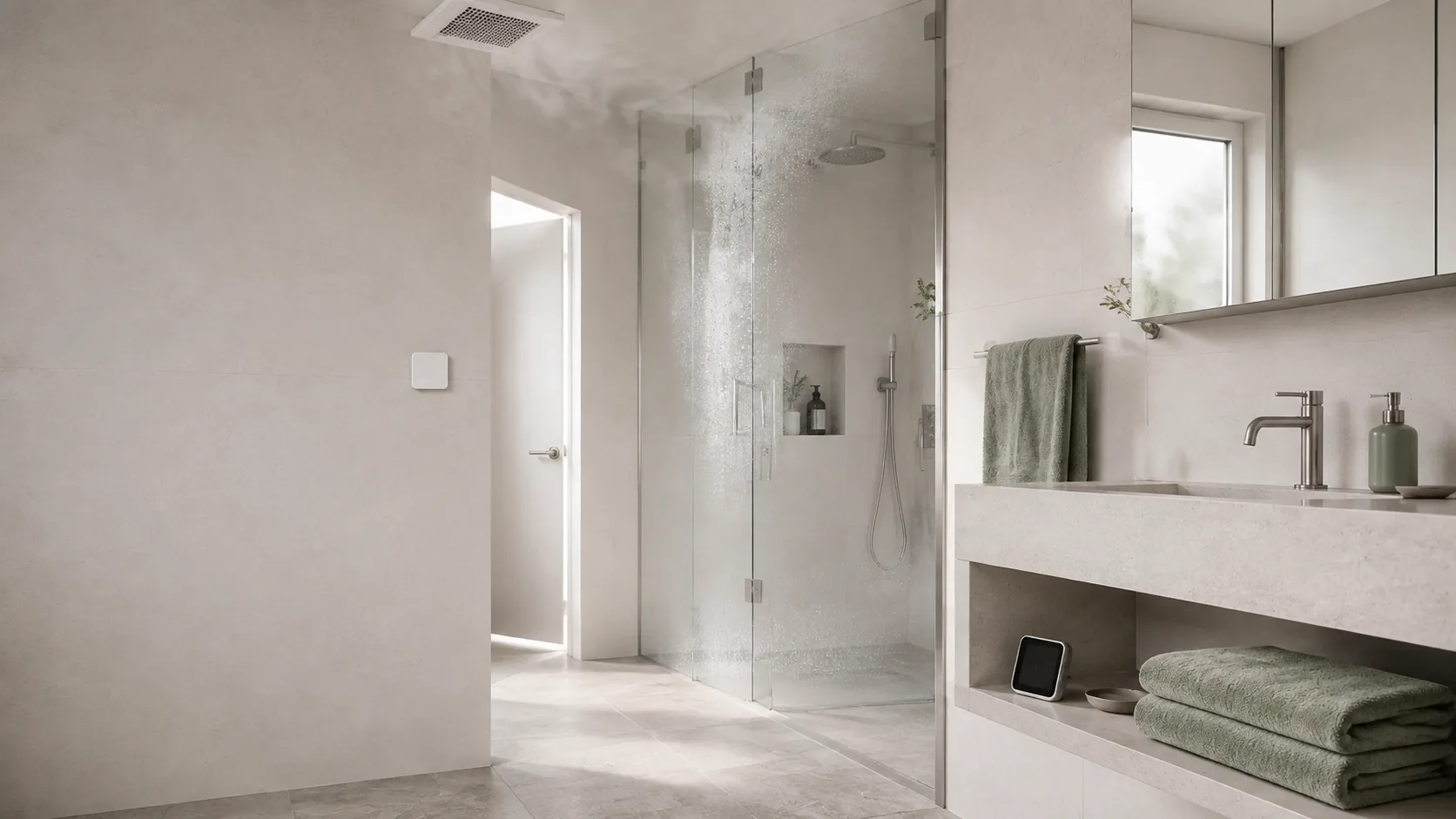
Why there is no perfect number for every bathroom
Shower length is only one part of the moisture load. Water temperature, shower enclosure, room volume, starting humidity, surface temperature and outdoor conditions all affect how much vapor remains in the room. Fan performance varies too: the rated airflow on the box may not equal the airflow delivered through a long, bent or restricted duct.
This is why common fixed recommendations can disagree. A strong, correctly installed fan in a small bathroom may clear the moisture quickly. A weak fan, blocked duct or missing replacement-air path can leave walls wet long after the timer ends. The goal is not to reach a particular minute count; it is to remove damp air outdoors and help surfaces dry. If occupants often forget the overrun, compare a fan timer with a humidity sensor before choosing a control.
A practical fan routine
1. Start the fan before or when the shower begins
Do not wait until the mirror is covered with condensation. Starting the fan as the shower begins removes moisture near the time it is produced and helps limit how much spreads into the rest of the home.
2. Keep it running throughout the shower
Leave the fan on for the entire bathing period. Confirm that it exhausts outdoors rather than into an attic, crawlspace, wall cavity or space between floors. The U.S. Environmental Protection Agency notes that bathroom ventilation should remove sufficient air and discharge it directly outside.
3. Continue running it after the shower
Use up to one hour after the shower as a conservative starting routine, especially while you are learning how the room behaves. A countdown timer can prevent the fan from being switched off too early or left on unintentionally. Follow the fan manufacturer's operating instructions and any controls that are part of an approved whole-house ventilation design.
4. Check humidity recovery and surface drying
Measure relative humidity from a dry, representative location away from the direct shower spray and the fan grille. Record the pre-shower level, the reading when the shower ends, and readings at consistent intervals afterward. Our bathroom humidity measurement guide explains the full test and includes a downloadable recovery log.
Also look at surfaces. The mirror is useful as an early clue, but check colder walls, windows, ceiling areas and grout too. A bathroom can feel comfortable while hidden or colder surfaces remain damp.
5. Adjust the timer—or investigate the system
If humidity is moving back toward the pre-shower baseline and surfaces are drying well before an hour, a shorter setting may be sufficient for that repeatable routine. If humidity stays elevated or condensation remains after an hour, do not simply keep extending the timer indefinitely. Check whether the fan, duct and replacement-air path are actually working.
How to judge whether the runtime is long enough
| What you observe | What it may mean | Next step |
|---|---|---|
| Humidity falls steadily and wet surfaces dry | The fan routine appears to be removing moisture | Repeat the same test on several similar showers before shortening the timer |
| Humidity falls at first, then stalls high | The room may have limited airflow, a continuing moisture source or humid replacement air | Check the air path, duct and outdoor conditions |
| Mirror clears but walls or ceiling stay wet | The visible mirror is not representing the coldest surfaces | Keep drying surfaces and inspect ventilation performance |
| Little change while the fan runs | Delivered airflow may be weak even if the motor is audible | Inspect the grille, damper, duct and outdoor termination; consider professional airflow measurement |
| Dampness returns without shower use | A leak or another moisture source may be present | Investigate the source rather than relying on fan runtime |
Relative humidity changes with temperature, so do not judge one isolated reading. Compare repeated tests under similar conditions and look for a recovery trend. The EPA generally recommends keeping indoor humidity below 60 percent and ideally between 30 and 50 percent, where feasible, but a brief shower peak is different from humidity that stays elevated.
If an hour is not enough
A longer timer cannot repair a failed moisture pathway. Work through the system in order:
- Clean accessible dust: Follow the manufacturer's instructions and disconnect power as required before removing a grille or servicing the unit.
- Check the outdoor termination: Confirm that the damper can open and that the outlet is not obstructed.
- Inspect the duct route: Long runs, sharp bends, crushed flexible duct, disconnected sections and undersized duct can reduce airflow.
- Provide the intended replacement-air path: An exhaust fan cannot move useful air from a tightly sealed room without a way for replacement air to enter. Do not alter a door or fire-rated assembly without appropriate guidance.
- Check fan size and delivered airflow: Use our bathroom exhaust fan sizing guide as a starting point, then have installed airflow measured when performance is uncertain.
- Look for non-shower moisture: Plumbing leaks, wet materials and moisture entering from another area require source correction.
For a broader routine, use the bathroom condensation checklist. If the bathroom has no dependable mechanical exhaust, compare an exhaust fan with an open window before relying on weather-dependent ventilation.
Timer switch vs. humidity sensor
A countdown timer is simple and predictable. It lets the user select a known post-shower period and then shuts the fan off automatically. It works best when the household uses a consistent routine and has already tested how long the room normally takes to recover.
A humidity-sensing control can react automatically, but placement, set point, temperature changes and sensor behavior affect when it starts and stops. A sensor should be treated as a control convenience, not proof that the fan delivers enough airflow. Follow the control and fan manufacturers' instructions, and verify the room's outcome after installation.
Some fans run continuously or are part of a whole-house ventilation system. Do not override that design with a simple shower timer. Continuous ventilation rates, balancing and controls should follow the approved system design and applicable requirements.
Safety and maintenance boundaries
Do not assume every fan is designed for unlimited continuous operation or for installation over a tub or shower. Use only the operating pattern and location allowed by the product listing and instructions. Never vent bathroom moisture into an enclosed part of the building.
Common runtime mistakes
- Starting after the shower: Moisture has already spread and condensed by the time the fan begins working.
- Using the mirror as the only test: Colder walls and ceiling areas may stay damp after the mirror clears.
- Choosing one number without measuring: The same 20-, 30- or 60-minute setting will not perform equally in every room.
- Running longer to hide weak airflow: A blocked or poorly installed duct needs correction, not an endless timer.
- Closing off replacement air: A fan needs a designed path for air to enter the room as damp air leaves.
- Ignoring the manufacturer's instructions: Controls, maintenance and permitted runtime vary by product.
Frequently asked questions
Is 20 minutes after a shower enough?
It may be enough in some bathrooms, but time alone does not prove moisture recovery. Test the humidity trend and surface drying. DOE Building America guidance recommends one hour after a shower for effective humidity control, so a shorter setting should be supported by repeat observations in your room.
Can I leave the bathroom fan on overnight?
Do not make that a default unless the fan and ventilation design are intended for continuous operation. Follow the manufacturer's instructions. If the bathroom needs many hours to dry after an ordinary shower, investigate airflow, the duct and other moisture sources.
Should I leave the bathroom door open?
The fan needs a replacement-air path, often provided by a designed door undercut or transfer opening. Opening the door may change airflow, but privacy, household conditions and building requirements matter. Do not cut or modify a door—especially a rated door—without appropriate advice.
Does a humidity-sensing fan know when the room is dry?
It responds to the conditions detected at its sensor and according to its settings. That can be useful, but it does not directly verify every wet surface or the delivered exhaust airflow. Check the room's recovery after installation.
Why is the bathroom still damp after the fan runs for an hour?
Possible reasons include weak delivered airflow, a restricted or disconnected duct, no effective replacement-air path, very humid incoming air, cold surfaces, a long shower or a leak. Diagnose the pathway rather than extending runtime without limit.
Bottom line
Run the bathroom fan during the full shower and continue afterward. One hour is a practical, evidence-based starting routine from DOE Building America guidance, but the final setting should be based on repeated humidity and drying checks. If an hour does not produce clear recovery, inspect the exhaust system and moisture source instead of treating the timer as the only solution.