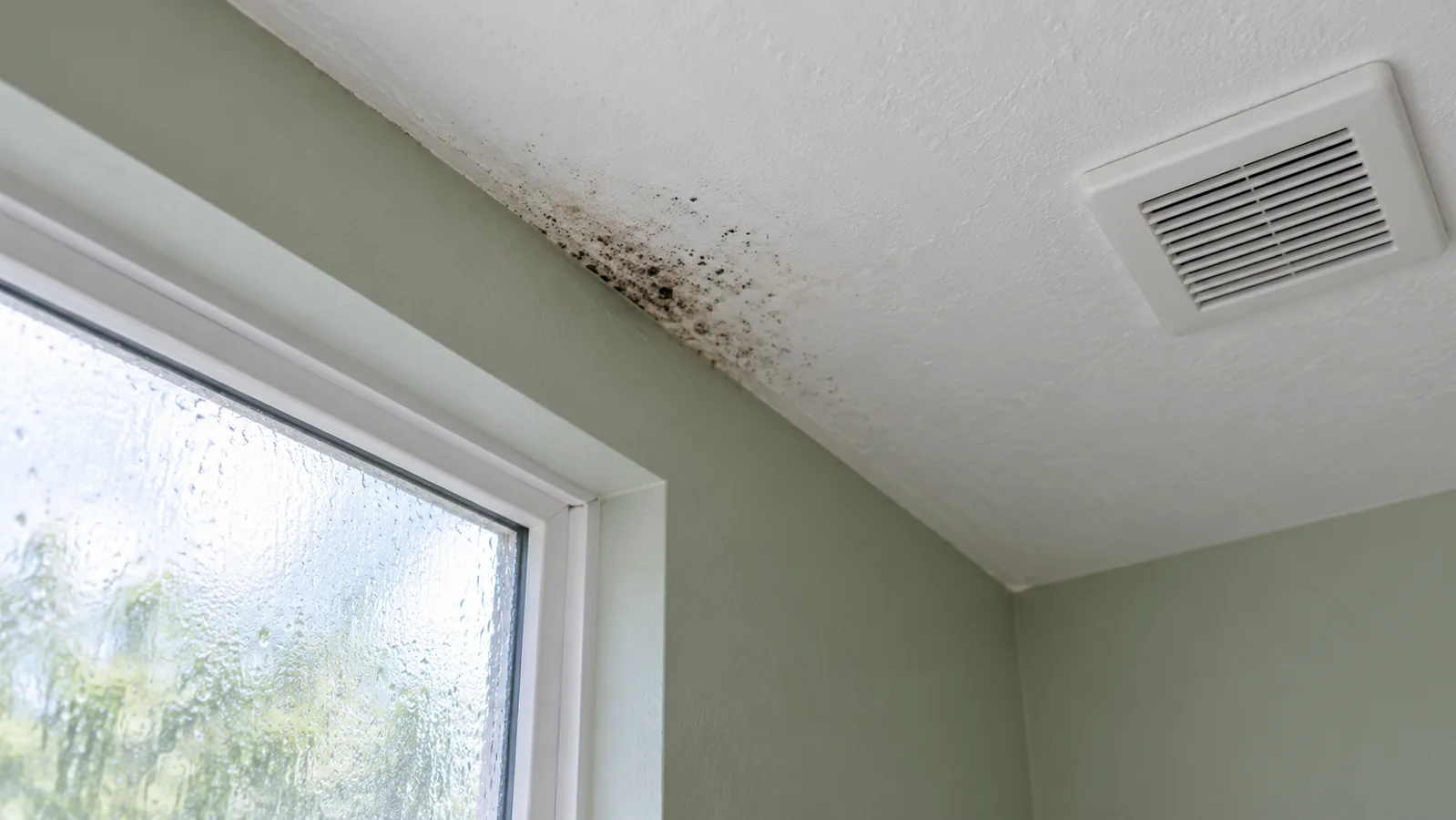
The short answer
Do not start by scraping, sanding or painting. First check whether the pattern follows showers or points to plumbing, roofing or another water source. The U.S. Environmental Protection Agency says moisture control is the key to mold control and advises cleaning and drying moldy surfaces rather than painting over them.
A small, isolated area may be suitable for homeowner cleanup when the surface and access are safe and there has not been extensive water damage. EPA uses about 10 square feet as a practical point below which most household cases can often be handled by the occupant. That is not a guarantee: porous ceiling material, recurring growth, contamination, health concerns or uncertainty can make professional help the safer choice.
Stop before cleaning if any of these apply
- The ceiling is sagging, soft, bulging or actively wet. Keep people out from under it. Shut off the water source only if the control is safely accessible, and contact the appropriate plumber, roofer, building manager or emergency service.
- Water is near a light, fan or other electrical fitting. Do not touch the wet area or electrical equipment. Have the electrical hazard and water source assessed before cleanup.
- The affected area is larger than about 10 square feet, follows major water damage or may involve sewage or contaminated water. EPA recommends professional guidance for larger or complicated jobs.
- You would need to cut, scrape or open the ceiling to investigate. Hidden growth can be disturbed, and older coatings or building materials can add hazards that are not visible from the room.
- Anyone doing the work has asthma, significant allergies, immune suppression or another health concern. CDC advises people with allergies, asthma, chronic respiratory disease, immune suppression or underlying lung disease not to take part in mold cleanup.
Condensation pattern or leak pattern?
Timing and location can help route the inspection, but they do not diagnose what is behind the ceiling.
| What you observe | What it may suggest | What it does not prove |
|---|---|---|
| Fine spotting develops across a cold ceiling and is worse after showers | Repeated surface condensation or slow drying | That the exhaust fan is correctly sized, ducted or moving its rated airflow |
| A localized ring or stain changes after rain, snowmelt or upstairs water use | A roof, flashing, plumbing or shared-building water path | The exact source directly above the stain; water can travel before it appears |
| Growth clusters near the shower while mirrors and walls stay wet for a long time | High moisture load, weak exhaust, poor replacement airflow or cold surfaces | That longer fan runtime alone will solve a blocked or poorly routed duct |
| The patch returns quickly after cleaning, even when the bathroom is rarely used | An unresolved leak, hidden damp material or another moisture source | That the visible surface is the full extent of the problem |
| Soft drywall, peeling layers or a sagging area | Material damage from repeated or active wetting | That the ceiling remains structurally safe to touch or work beneath |
A safe five-step check
- Document without disturbing. Photograph the area from the floor in good light and note its approximate size, location and date. Do not rub it to identify texture or color.
- Compare the timing. Note whether the mark changes after showers, rain or plumbing use above the room. If it is actively spreading or dripping, stop and route the water source first.
- Check drying behavior. Run a correctly vented exhaust fan during bathing and afterward. If steam and surface water linger, use our bathroom fan test and confirm where the fan vents. A running motor is not proof of useful airflow.
- Look only where access is already safe. From the room, check for obvious plumbing fixtures, roof transitions or an occupied space above. Do not enter a wet attic, climb on damp surfaces or open the ceiling. A qualified trade can inspect the relevant system.
- Correct the source before finishing. Repair the leak, restore reliable exhaust or address the cold-surface/airflow pattern. Cleaning and paint cannot substitute for moisture control.
When a small-area cleanup may be reasonable
EPA says that, in most cases, an area smaller than about 10 square feet can be handled by the occupant. That guidance assumes the job is uncomplicated and the person can work safely. Follow the EPA and CDC instructions linked below rather than improvising a chemical mixture.
- Wear the protective equipment CDC recommends for mold cleanup, keep other people away from the work area and ventilate as directed.
- For a hard, washable surface, EPA advises scrubbing with detergent and water and drying the surface completely.
- Porous materials—including some ceiling tiles and damaged drywall—may be difficult or impossible to clean completely and may require removal and replacement.
- Never mix bleach with ammonia or any other cleaner. CDC warns that mixing cleaners can release dangerous vapors. Follow every product label and local disposal requirement.
- Do not paint or caulk over visible growth. EPA says to clean and dry the surface first; paint over a moldy surface is likely to peel.
Do you need a mold test?
Usually not for visible growth. EPA says sampling is unnecessary in most cases when mold is already visible, and there are no federal mold-spore limits that a household test can use to declare a building compliant. Testing also does not replace finding and correcting the moisture source.
Professional sampling can be useful in limited circumstances, including when a qualified professional is designing an investigation or checking whether a remediation was effective. If hidden growth is suspected, do not open the ceiling merely to collect a sample; EPA warns that disturbing hidden growth can release spores.
Prevent the ceiling from becoming damp again
- Exhaust outdoors. A bathroom fan should move moist air out of the building, not into an attic, wall cavity or other enclosed space.
- Run it for the recovery period. Start the fan before or at the beginning of bathing and keep it on until moisture indicators are moving back toward their normal level. Use the practical checks in how long to run a bathroom fan after a shower.
- Give the fan replacement air. A closed room still needs a path for drier air to enter. A door undercut or designed transfer path can help; do not defeat fire, smoke or acoustic assemblies.
- Remove surface water. Squeegee shower walls, hang towels so they can dry and wipe persistent water from ledges rather than asking the fan to evaporate all of it.
- Track trends, not one reading. A hygrometer can show whether the room recovers after bathing. Our bathroom hygrometer guide explains placement and repeat checks.
- Recheck the repaired condition. A dry day or one clean week does not prove a rain-dependent, seasonal or intermittent leak is solved.
Who to call first
- Plumber: the pattern follows fixture, supply or drain use.
- Roofer or building-envelope professional: it follows rain, thaw or roof-edge conditions.
- Electrician: water is near a fan, light, cable or electrical box.
- Ventilation contractor: the fan runs but measured airflow is weak, the duct route is uncertain or the system discharges indoors.
- Experienced mold remediator: the area is large, recurring, hidden, contaminated or beyond a safe household cleanup.
More than one trade may be needed. Stopping water entry is not the same as clearing electrical equipment, drying concealed material or completing remediation.
Common questions
Can color tell me what kind of mold it is?
No. Treat color as a description, not a species or risk diagnosis. The useful decision is whether there is visible growth, how extensive it is, what is keeping the ceiling damp and whether cleanup can be done safely.
Can I use mold-resistant paint instead of cleaning?
No. Coatings may be part of a properly prepared finish after the source is corrected and the substrate is clean and dry. They do not remediate growth or repair damp material.
What if the spots return only in winter?
That pattern can be consistent with condensation on a colder surface, but it does not rule out a roof or insulation defect. Compare shower timing, weather and drying performance, then have the relevant system inspected if the pattern persists.
Will a dehumidifier fix ceiling mold?
A dehumidifier may help lower room humidity, but it does not replace source control, outdoor exhaust or leak repair. See our exhaust fan versus dehumidifier comparison before choosing a tool.