What a musty bathroom smell can—and cannot—tell you
The U.S. Environmental Protection Agency says areas that smell moldy or musty should be investigated for water entry and possible growth. That makes the odor useful as an early warning, but not as a laboratory result. Damp towels, a wet bath mat, slow-drying grout, a plumbing leak, condensation on cold surfaces and moisture inside a cabinet can create similar clues.
Do not try to identify a mold species by smell. The Centers for Disease Control and Prevention does not recommend routine home mold testing, and the EPA says sampling is generally unnecessary when visible growth is already present. The practical task is to find and correct the moisture source, then clean or remove affected material safely.
1. Describe when and where the odor appears
Before adding fragrance or running every device at once, write down the pattern. Smell is subjective, but timing and location can narrow the next check.
- After showers only: Focus first on wet surfaces, fabrics and the room's ventilation recovery.
- All day: Check the starting humidity, cabinets, plumbing connections and materials that never seem to dry.
- Strongest near one wall or ceiling area: Look for staining, peeling paint, softness or a history of roof, pipe or neighboring-room leaks.
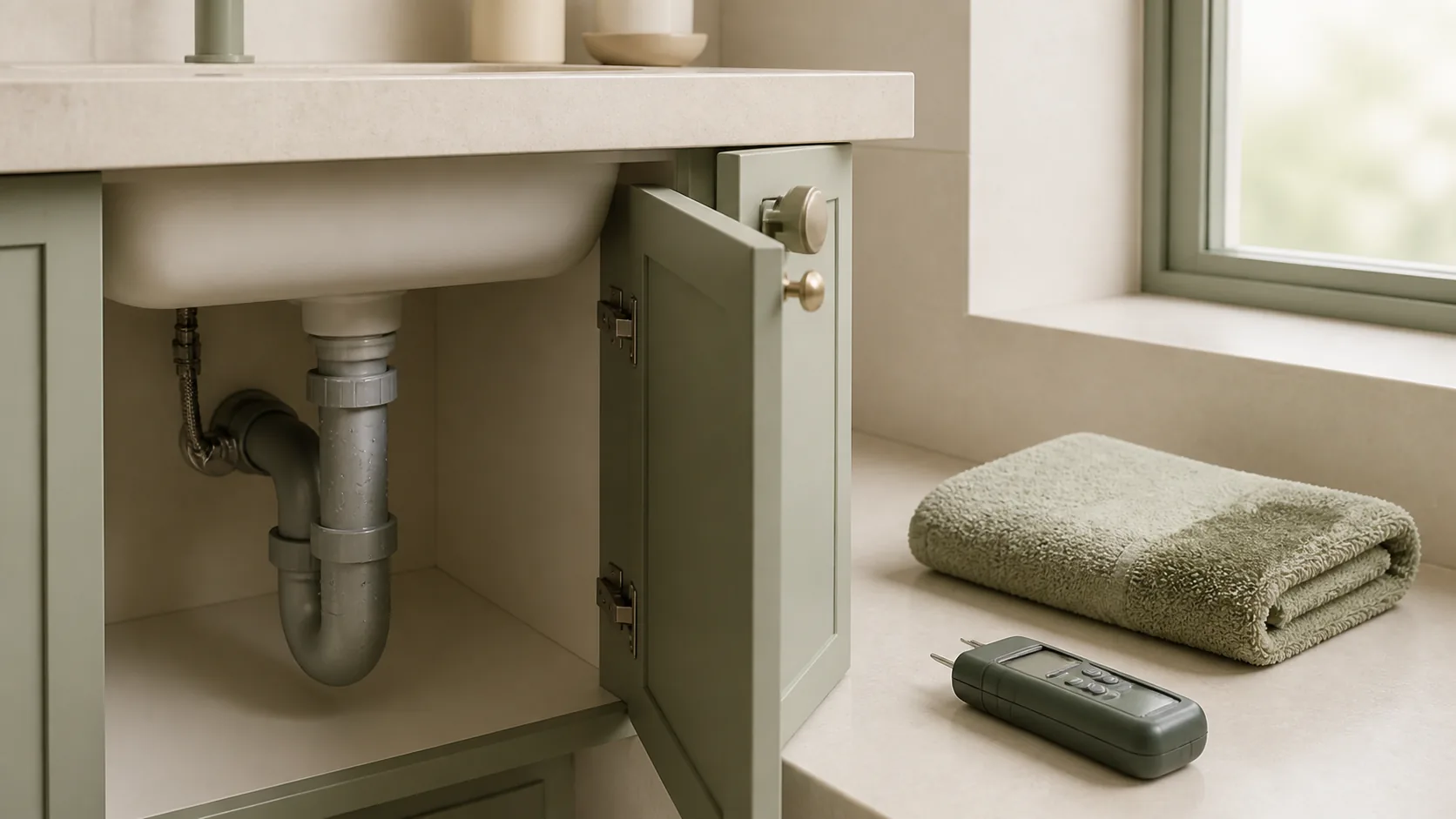
- Strongest at the vanity: Inspect accessible supply and drain connections, the cabinet base and stored items for moisture.
- Strongest near towels or mats: Remove those items from the room and dry or launder them according to their care labels before judging the building.
A smell that disappears when one damp item is removed points to a different task than an odor that returns from a fixed building surface. Note what changed instead of assuming the first suspected cause is correct.
2. Remove obvious damp items and standing water
Start with the low-risk sources you can see and handle. Hang towels where air reaches both sides, dry bath mats fully, spread shower curtains and liners, empty wet hampers, and wipe or squeegee accessible standing water. Follow each item's care instructions.
Then let the room go through a normal drying cycle. If the odor fades and stays away, repeat the improved fabric and surface routine after several showers. If it returns while the items are dry, continue the investigation instead of covering the odor with sprays.
The EPA emphasizes drying wet materials quickly—generally within 24 to 48 hours—to reduce the opportunity for mold growth. That window is prevention guidance, not proof that a material is safe or mold-free after a particular number of hours.
3. Inspect for leaks and damaged materials
With the bathroom dry and well lit, check accessible areas without dismantling plumbing or opening the building:
- Under the sink and around supply valves and drain connections
- Around the toilet base without rocking or loosening the fixture
- At the tub or shower edge, door track and nearby floor
- Below windows and on exterior-facing walls
- At ceiling penetrations and below rooms or roof areas with a leak history
- Inside vanity cabinets and behind movable, lightweight storage
Look for active droplets, swollen cabinet panels, cracked or lifting finishes, recurring stains, soft drywall, loose flooring and corrosion. EPA prevention guidance specifically calls out rippling wall coverings, cracked drywall tape, peeling paint and other signs of water damage for prompt investigation.
4. Measure humidity and recovery
A hygrometer can show whether the room starts damp and whether it recovers after bathing. Place it on a dry, stable surface away from direct spray, concentrated steam, a cold window and the exhaust grille. Record relative humidity and temperature before the shower, shortly after it ends and at regular intervals afterward.
The EPA advises keeping indoor relative humidity below 60 percent where possible and ideally between 30 and 50 percent. A shower can cause a temporary rise, so do not judge the room from one peak. Compare the trend with the room's usual baseline and watch whether walls, glass, grout and fabrics actually dry.
Use the full bathroom humidity measurement guide and its downloadable log for a repeatable test. If the bathroom begins high even when unused, compare nearby rooms and investigate a wider-home moisture source rather than blaming the last shower.
5. Check the ventilation path
A bathroom exhaust fan should remove damp room air and discharge it outdoors. The Department of Energy's Building America Solution Center says bathroom fans should not terminate in an attic, crawlspace, garage, wall cavity or space between floors. A motor sound alone does not confirm useful airflow or the duct destination.
- Run the fan while bathing and continue afterward according to the model and ventilation design.
- Keep the grille and the intended replacement-air path clear.
- With dry hands and a dry floor, note whether a lightweight tissue is drawn toward the grille; treat this only as a clue, not a CFM measurement.
- If the outdoor termination is safely visible from the ground, check whether its damper opens while the fan runs. Do not climb onto a roof.
- Use the safe fan-cleaning guide for accessible dust, or arrange service for duct, wiring and installed-airflow checks.
Our post-shower fan runtime guide explains how to connect timer settings with actual humidity and surface recovery. If the room has no dependable exhaust, compare the roles of a dehumidifier and exhaust fan before adding an electrical appliance near water.
6. Handle visible growth within safe limits
If you see growth, fixing the water problem is part of the cleanup. Painting, caulking or fragrancing over it does not remove the source. The EPA says that, in most cases, an area smaller than about 10 square feet may be suitable for homeowner cleanup, but size is only one boundary.
Read the EPA's current cleanup guidance before starting. Follow product labels, provide appropriate ventilation and keep cleaning products away from children and pets. Never mix cleaning products. Porous materials may be difficult or impossible to clean completely, and a stain can remain even after material has been treated.
Do not treat the 10-square-foot guideline as automatic permission to proceed. Arrange professional advice when:
- The affected area is larger, keeps returning or may extend inside a wall, ceiling, floor or HVAC system.
- Water came from sewage, flooding or another contaminated source.
- Drywall, insulation, subflooring or other building material is soft, swollen or deteriorating.
- Cleanup would disturb wiring, a ceiling, structural material or inaccessible ductwork.
- A resident has asthma, a mold allergy, chronic lung disease or a weakened immune system and needs health-specific guidance.
- You cannot identify and stop the moisture source.
The CDC notes that damp and moldy environments affect people differently. This article cannot determine whether an odor is causing symptoms. Seek medical advice for personal health concerns and urgent care for severe symptoms.
7. Repeat the check before calling it solved
After drying, repair and permitted cleaning, return to the same observation points. Use similar shower conditions, keep the ventilation routine consistent and record whether the odor returns. Recheck the cabinet base, damaged finishes, towels, mats, humidity trend and visible surface drying.
| What happens next | What to do |
|---|---|
| Odor disappears after damp fabrics are removed | Improve the laundry and drying routine, then repeat the check after several showers |
| Odor tracks a visible plumbing drip | Stop the leak safely and assess affected materials; use a plumber when the repair is outside your scope |
| Humidity and surfaces recover slowly | Review fan operation, ducting, replacement air and the wider home's humidity |
| Odor returns from one fixed surface | Arrange a moisture and material inspection rather than repeatedly deodorizing it |
| Visible growth returns after cleaning | Assume the moisture source or affected material has not been fully resolved |
| No source is visible but the smell persists | Ask a qualified building professional to investigate hidden moisture without unnecessary demolition |
Common musty-odor mistakes
- Masking the smell first: Fragrance can make it harder to tell whether the moisture problem changed.
- Assuming odor proves mold: The smell is a reason to investigate, not a species or exposure test.
- Cleaning without fixing water: Growth and odor are likely to return while materials stay damp.
- Watching only the mirror: Cold walls, cabinets and fabrics may remain wet after glass clears.
- Buying equipment before finding the source: A dehumidifier cannot repair a leak or a duct that terminates inside the building.
- Opening walls without a plan: Hidden electrical, plumbing and contaminated materials require controlled investigation.
Frequently asked questions
Does a musty smell always mean mold?
No. A musty odor can accompany damp materials or mold growth, but smell alone cannot identify the source or type. Investigate moisture, visible damage, leaks, fabrics, humidity recovery and ventilation instead of treating odor as a diagnosis.
Can a bathroom smell musty without visible mold?
Yes. Moisture or growth may be behind a finish or inside a cabinet, while wet fabrics and slow-drying surfaces can also smell stale. Do not open walls casually; document the strongest location and arrange inspection if accessible checks do not find the source.
Will running the exhaust fan remove the smell?
It may clear damp air and help surfaces dry when the fan delivers useful airflow outdoors. It will not repair a leak, clean affected material or correct a disconnected duct. Judge the result by repeat humidity, drying and odor checks.
Should I buy a mold test kit?
Routine home mold testing is generally not the first step. The CDC does not recommend mold testing, and the EPA says sampling is usually unnecessary when visible growth is present. Correct the moisture problem and use appropriate cleanup or professional assessment.
When should a renter contact the property manager?
Report active leaks, recurring stains, soft or swollen materials, persistent odor, visible growth and a fan that does not work or appears not to vent outdoors. Keep dated notes and photos, and do not make unauthorized electrical, plumbing, duct or building changes.
Bottom line
When a bathroom smells musty, treat the odor as a prompt to trace moisture: remove damp items, inspect accessible leaks and damage, measure recovery, and verify the ventilation path. Fixing the source matters more than masking the smell. If the problem is hidden, extensive, recurring or unsafe to reach, stop the do-it-yourself investigation and arrange qualified help.
For a broader drying plan, use the bathroom condensation checklist.