The direct answer
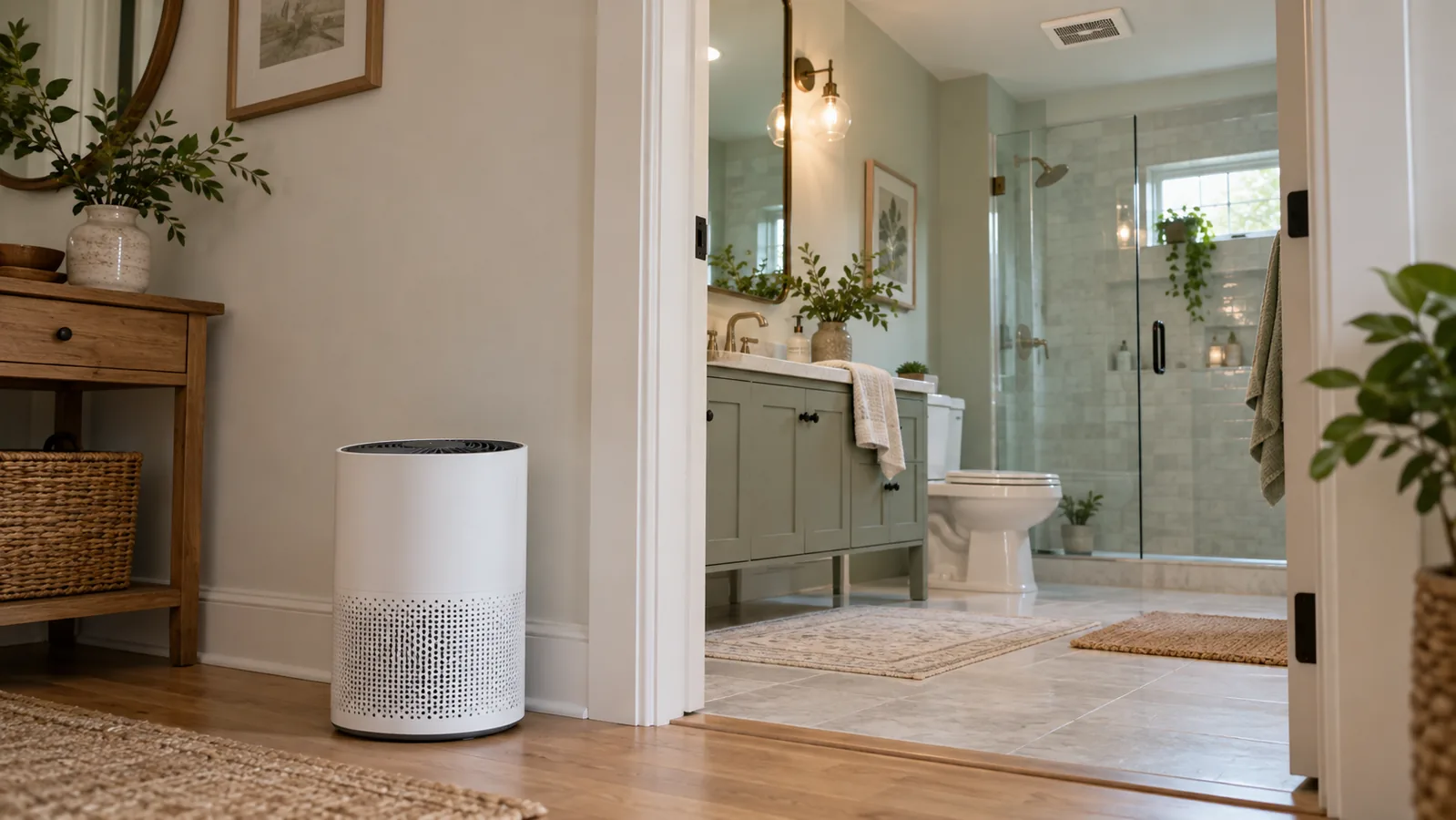
No—an air purifier cannot replace a bathroom exhaust fan for shower moisture. A typical portable air cleaner recirculates room air through filters to reduce selected airborne particles and, in some models, some gases. A properly ducted bathroom exhaust fan removes humid bathroom air and discharges it outdoors. Filtration does not turn water vapor into outdoor exhaust.
An air purifier may have a separate supporting role for a particle or odor concern, but it does not correct high humidity, condensation, a blocked duct, a fan that terminates in an attic, or a water leak.
Air cleaning and exhaust ventilation do different jobs
What a bathroom exhaust fan does
A bathroom fan is source ventilation. It captures warm, humid air near the shower or bath, moves that air through a duct and should terminate outdoors. The U.S. Environmental Protection Agency recommends using bathroom exhaust fans to remove moisture to the outside rather than into an attic or another enclosed space.
That moisture-removal job matters because persistent dampness, wet finishes and slow humidity recovery create conditions in which condensation and microbial growth can become harder to control. If you are unsure where your duct ends, follow the safe checks in our guide to confirming that a bathroom fan vents outside.
What an air purifier does
A portable air cleaner normally pulls room air through one or more filters and returns the filtered air to the room. EPA guidance explains that these devices may remove particles and, when specifically designed for it, some gases. Results depend on the pollutant, filter design, airflow, room size, operating time and maintenance.
The same guidance emphasizes that air cleaning does not replace source control and ventilation. A particle filter may collect some airborne dust or particles, but it does not drain a wet bath mat, repair a leak, dry a wall cavity or exhaust shower-generated water vapor outdoors.
Air purifier vs. bathroom exhaust fan
| Question | Air purifier | Exhaust fan |
|---|---|---|
| Removes shower moisture outdoors? | No. A typical air cleaner recirculates indoor air and is not a dehumidifier. | Yes, when the fan works and its duct terminates outdoors. |
| Reduces selected airborne particles? | Potentially, with a suitable particle filter, adequate airflow and regular filter changes. | It can exhaust some bathroom air, but it is not rated as a room particle filter. |
| Helps with odors? | Sometimes. A model designed for gases may reduce some odors, but performance varies and source removal comes first. | Often helps by removing humid, stale air and contaminants at the source. |
| Fixes recurring mold or musty odor? | No. Air cleaning does not fix the moisture source or remove damaged material. | Not by itself. Ventilation helps, but leaks, wet materials and duct defects still need correction. |
| Needs a duct? | No; it recirculates air within the space. | Yes; bathroom exhaust should be ducted to a dedicated outdoor termination. |
| Best role | A supplementary tool for a defined airborne-pollutant goal. | The primary tool for removing shower moisture at the source. |
Humidity and condensation
If mirrors stay fogged, water beads on walls or relative humidity remains elevated long after bathing, focus first on moisture removal. Check that the fan draws air, that the exterior outlet opens, and that the room recovers after use. Test the bathroom exhaust fan with intake, outlet and room-recovery checks; do not use motor noise or a tissue check as proof of rated airflow.
For repeatable evidence, measure bathroom humidity before and after comparable showers. The trend and recovery time are more useful than one isolated reading.
Particles, gases and odors
If the moisture problem is already controlled but you have a separate airborne-particle concern, an appropriately sized portable air cleaner may help in a dry, manufacturer-approved location. For odors, look for a product specifically designed to remove gases; a particle-only filter should not be presented as an odor cure. Replace filters on schedule and understand that a small amount of sorbent material may become exhausted quickly.
A musty smell is a reason to inspect for damp materials, leaks and slow drying—not a reason to cover the symptom. Use the musty-bathroom checklist to trace the source without treating odor alone as a mold diagnosis.
Ozone is not a shortcut
Do not choose an ozone generator as a bathroom air-cleaning solution. EPA identifies ozone as a lung irritant and reports that concentrations within public-health standards are generally ineffective at controlling indoor air pollution. Choose mechanical filtration for particles and avoid products marketed around intentional ozone production.
Electrical and placement safety comes first
Keep portable electrical equipment out of wet and splash-prone areas unless the manufacturer explicitly lists the product for that location and use. A GFCI is an important shock-protection layer near water, but it does not make water exposure, a wet cord or unsafe placement acceptable.
Do not place an ordinary floor-standing air purifier beside a tub, shower, sink splash zone or on a wet floor. Do not handle its plug with wet hands or run a cord where it can be splashed, pinched or tripped over. Follow the product manual and all local electrical requirements. If you want supplementary air cleaning, the safer default is a stable, dry location outside the bathroom doorway, provided the manufacturer permits that setup and the unit has unobstructed airflow.
If an appliance, receptacle or cord becomes wet, if a fan drips water, or if you notice sparking, crackling, a burning smell, heat or damaged wiring, stop using the equipment. Keep people away and isolate power only if you can do so without entering a wet area or touching wet equipment. Arrange evaluation by a qualified electrician or the appropriate trade. For a leaking fan, start with the fan-drip safety checklist.
What to do in your bathroom
- Define the problem. Condensation and slow humidity recovery point to moisture control. Dust, pollen or smoke particles are a different target. A musty odor calls for source investigation.
- Keep or restore source ventilation. Run a working fan during bathing and until the room recovers. If the duct is missing, blocked or discharges indoors, have the route corrected.
- Measure recovery. Record humidity before bathing, at the end, and at consistent intervals afterward. Compare similar shower conditions.
- Use an air cleaner only for a separate goal. Match its clean-air delivery to the room and pollutant, follow its label and keep it in a dry, safe location.
- Escalate persistent problems. Repeated wet surfaces, visible growth, leaks, damaged finishes or poor airflow need source correction rather than more filtration.
When both may be reasonable
Both devices can make sense when a bathroom has working exterior-ducted ventilation and the household also has a defined particle or gas concern. In that arrangement, the fan handles shower moisture while the air cleaner serves its separately specified pollutant target. The purifier remains supplementary, not a substitute.
When a dehumidifier is the closer comparison
If your real question is how to lower humidity when ventilation is limited, an air purifier is the wrong category of product. Read our bathroom dehumidifier vs. exhaust fan comparison. Even then, placement, electrical safety, drainage and source ventilation still matter.
Bottom line
For shower moisture, prioritize a correctly sized, exterior-ducted exhaust fan and verify that the whole system works. Consider an air purifier only for a separate airborne-pollutant objective, in a dry and approved location. If the room stays wet, work through the condensation checklist rather than adding filtration and hoping the moisture disappears.
Sources and further reading
- U.S. EPA: Guide to Air Cleaners in the Home
- U.S. EPA: Improving Indoor Air Quality
- U.S. EPA: Main Ways to Control Moisture in Your Home
- U.S. EPA: A Brief Guide to Mold, Moisture and Your Home
- U.S. EPA: Ozone Generators That Are Sold as Air Cleaners
- ENERGY STAR: Ventilation Fans Key Product Criteria
- Home Ventilating Institute: Bathroom Exhaust Fans
- U.S. Consumer Product Safety Commission: GFCI Fact Sheet
Editorial note: DryBath Guide separates observed room conditions from hidden-cause diagnosis. This article was reviewed against the cited public-health, ventilation-performance and electrical-safety guidance. It is general information, not a substitute for product instructions, local requirements or an on-site professional assessment.