The practical difference
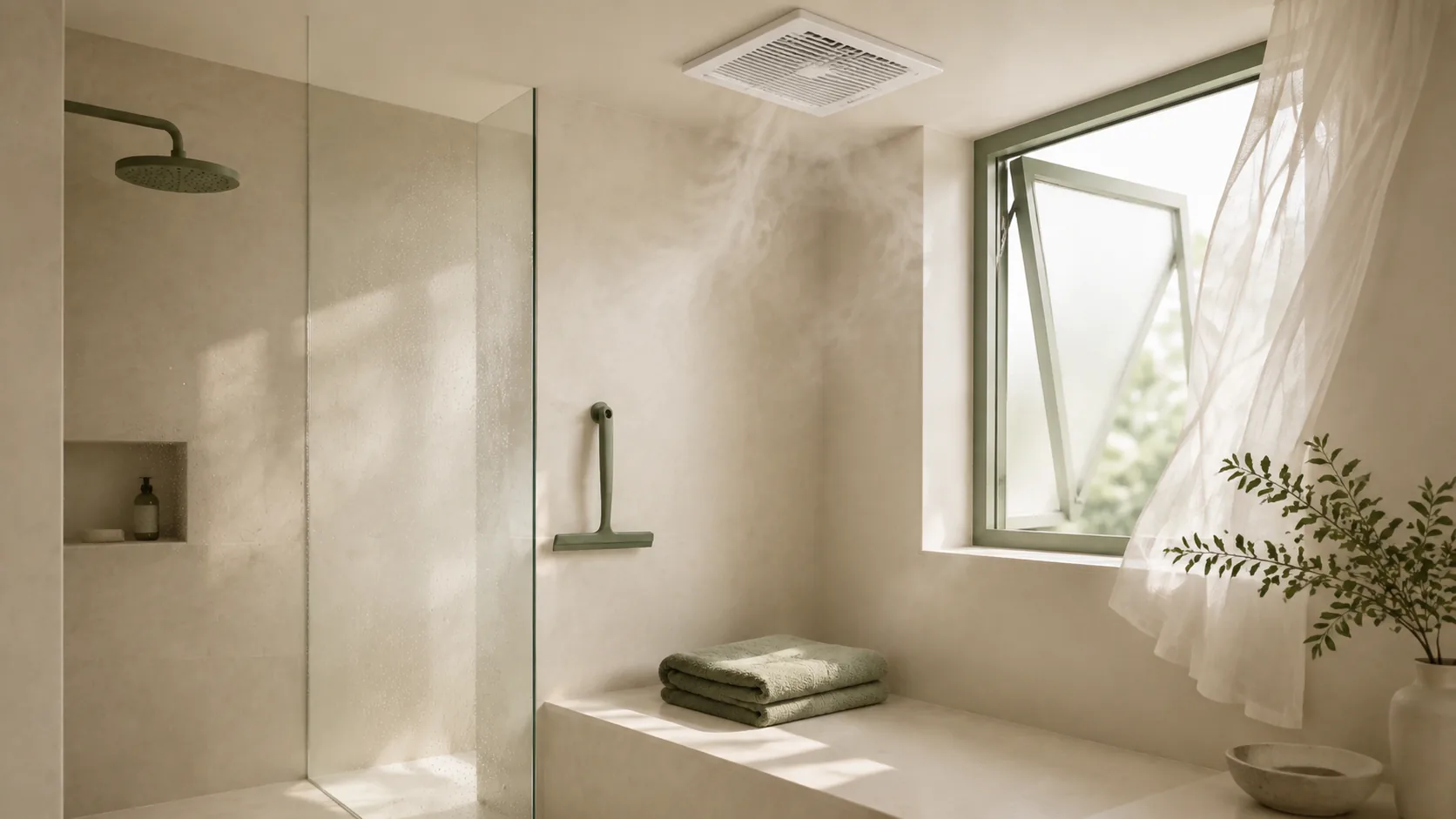
An exhaust fan actively pulls bathroom air toward a duct and, when the system is correctly designed, sends that air outdoors. An open window creates a passive opening. Air movement through that opening depends on wind, indoor-outdoor temperature differences and whether the room has another path for replacement air.
That difference matters after a shower. Steam does not disappear simply because an opening exists. Moist air needs a clear route out, and drier replacement air needs a route in. A fan creates a more deliberate flow; a window relies more heavily on conditions you cannot control.
| Question | Exhaust fan | Open window |
|---|---|---|
| How air moves | Powered airflow toward an outdoor duct | Passive airflow driven by weather and pressure |
| Consistency | More repeatable when sized, ducted and maintained correctly | Variable from one day to the next |
| Weather dependence | Lower, though makeup air still matters | High; rain, heat, cold and outdoor humidity affect use |
| Installation | May require duct, electrical and building work | No new equipment if a suitable window already exists |
| Privacy and security | No open exterior access point during operation | May be unsuitable in some locations or at some times |
| Maintenance | Grille, fan and duct path need attention | Screen, frame and drainage path need attention |
When an exhaust fan is the better primary option
A working fan is generally easier to use as a routine: switch it on during bathing and leave it running long enough for conditions to move back toward the bathroom's usual level. It does not require favorable wind or a comfortable outdoor temperature.
Start with the fan when:
- The bathroom has no exterior window.
- Opening the window would create a privacy, security or weather problem.
- Outdoor air is often humid, hot, cold, smoky or otherwise unsuitable.
- The room needs a consistent ventilation method throughout the year.
- Condensation appears mainly during bathing and the fan is intended to vent outdoors.
A noisy fan is not proof of useful airflow. Dust at the grille, a long or restricted duct, a blocked outlet or a tightly sealed door can reduce performance. If electrical or duct work is involved, use a qualified professional and follow local requirements.
When opening a window may help
A window may provide useful cross-ventilation when outdoor air is suitable and another opening allows air to move through the room. It can be particularly practical in a bathroom without a fan when a renter or homeowner cannot immediately change the building.
A window is more likely to help when:
- Outdoor air is drier than the bathroom air.
- Rain cannot enter and the sill drains correctly.
- The opening does not create a security or privacy concern.
- A door gap or other intended air path supports through-flow.
- You can keep the window open long enough for surfaces and air to recover.
Opening a window a small amount does not guarantee that damp air will leave. On a still day, airflow may be weak. Wind can also push outdoor air into the bathroom rather than draw bathroom air out. Use observation and repeat humidity readings instead of relying on the window position alone.
Why outdoor conditions change the answer
An open window connects the bathroom directly to outdoor air. That can speed drying when the outdoor air is favorable, but it can slow recovery when the outside air already contains a great deal of moisture. Cold outdoor air can also cool nearby surfaces, making condensation more likely on glass, tile or exterior walls even while some air is exchanged.
Check the room rather than following one rule in every season. The most useful signs are whether the humidity reading begins to fall, whether the mirror clears and whether wet surfaces dry in a reasonable and repeatable period. Our bathroom humidity measurement guide explains how to compare those conditions without overreacting to a single peak.
Can you use the fan and window together?
Sometimes. A fan needs replacement air, and an open window can provide it. But the window's location matters. If the window sits very close to the fan, incoming air may take a short path directly to the grille while moisture elsewhere in the room lingers. In other layouts, a partially open window can support useful cross-flow.
Test one arrangement at a time. Compare fan-only operation with fan-plus-window operation under similar shower conditions. Keep the bathroom door position, shower duration and measurement location consistent. Use the arrangement that produces a reliable recovery pattern without creating weather, safety or comfort problems.
What renters should consider
Renters often have fewer options for altering ducts or electrical controls. Start by keeping the existing grille clean, using the fan as instructed, preserving the intended door gap and documenting persistent condensation or damage for the property manager. Do not dismantle wiring, cut ducts or make building changes without authorization.
If the bathroom has no working exhaust route, a suitable window may be the available short-term ventilation method. A portable dehumidifier is another separate option, but it requires safe placement, maintenance and strict attention to electrical safety near water. See our dehumidifier vs. exhaust fan comparison before adding equipment.
A simple decision check
- Confirm the available routes. Is there a fan, a window or both?
- Check the fan's destination. Does it actually discharge outdoors?
- Consider the outdoor air. Would opening the window bring in rain, humidity, smoke, extreme heat or cold?
- Check privacy and security. Can the window stay open safely for the needed period?
- Create a makeup-air path. Avoid blocking the intended door gap or transfer grille.
- Measure recovery. Compare repeat readings and visible drying rather than one steamy moment.
- Escalate building defects. Persistent damage, leaks, staining or electrical concerns need qualified inspection.
Frequently asked questions
Is an open window enough for bathroom ventilation?
It can help, but it is not consistently effective in every room or season. Performance depends on wind, outdoor humidity, temperature and the availability of another air path. If the room has a correctly installed exhaust fan, that fan is usually the more predictable primary method.
Should I open the bathroom window in winter?
Only when weather, comfort and building conditions make it appropriate. Cold air may increase local surface cooling near the window, while a brief opening may still exchange air. Watch the actual recovery pattern and avoid leaving the room vulnerable to rain, freezing conditions or damage.
How long should the fan or window be used?
There is no single duration that fits every bathroom. Use either method long enough for humidity to move back toward the room's baseline and for visible condensation to clear. Repeat measurements are more useful than choosing an arbitrary timer setting.
Bottom line
In the bathroom exhaust fan vs. open window decision, the fan is the more controlled primary route when it is properly installed, vented outdoors and supplied with replacement air. A window can be a useful supplement or practical fallback under favorable conditions. Whichever method you use, confirm the result by tracking recovery and following a repeatable condensation-reduction routine.