The practical difference
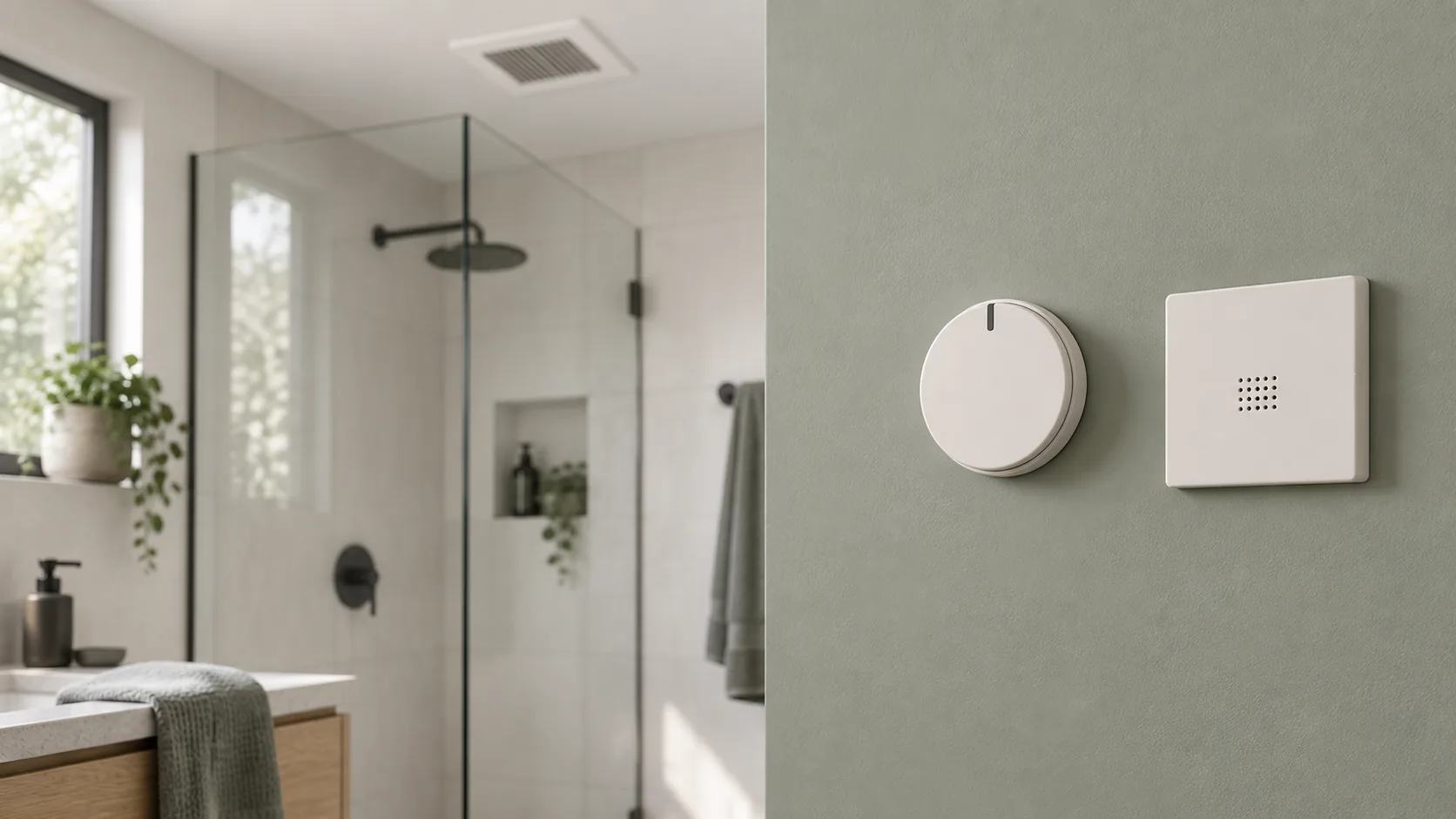
A countdown timer is time-based. Someone starts the fan, selects a period and the control turns it off at the end. A humidity sensor is condition-based: depending on the model, it responds to a relative-humidity threshold, a rapid rise in humidity or both, then runs the fan according to its programmed behavior.
The U.S. Department of Energy's Building America Solution Center recommends a timer rather than a standard wall switch for an intermittently operated bathroom fan. The Home Ventilating Institute also identifies timers and humidistats as available automatic-control features. Neither source makes one control universally best for every room, so the useful question is which failure you are trying to prevent: a forgotten fan, a run that ends too soon or a sensor that needs better adjustment.
| Criterion | Timer control | Humidity sensor |
|---|---|---|
| Trigger | Manual start or a model-specific linked control | Humidity change or threshold, depending on the model |
| Shutoff | After the selected countdown | After the programmed humidity or delay conditions are met |
| Main strength | Predictable behavior that is easy to observe | Can react without someone remembering to start it |
| Main limitation | Does nothing if nobody activates it | Placement, seasonal baseline and settings can affect behavior |
| Best fit | Regular routines and users who remember the switch | Variable showers or frequent missed starts |
| How to verify | Check that the selected period produces recovery | Check activation, run behavior and recovery across repeat showers |
When a timer is the better fit
A timer is the clearer choice when the fan already moves air well and the remaining problem is stopping it too early or leaving it on indefinitely. Its behavior is visible: choose a run period, observe the room and adjust within the limits of the fan and control instructions.
Favor a timer when:
- Users already remember to turn the fan on during bathing.
- Shower length and moisture load are fairly consistent.
- You want a deliberate post-shower run without estimating at the wall switch.
- The bathroom's humidity baseline changes enough that a fixed sensor threshold could require frequent adjustment.
- You need straightforward controls for guests or a shared household.
Do not pick a timer duration only because it sounds standard. Start with the fan and control instructions, then use the post-shower fan runtime and recovery guide to check whether humidity trends back toward baseline and visible water clears. A longer countdown is not a repair for poor airflow.
When a humidity sensor is the better fit
A humidity-sensing control can reduce reliance on memory. That is useful where people often forget the fan, bathing patterns vary or a compatible fan has an automatic boost mode. Some sensors are built into the fan; others are wall controls. Their trigger logic, allowed loads, adjustment method and manual-override behavior are model-specific.
Favor a humidity sensor when:
- The fan is frequently left off during showers.
- Moisture loads vary and one countdown is often too short or unnecessarily long.
- The sensor can be located and configured as its manufacturer requires.
- You can test the control across several representative showers.
- A clear manual override remains available when odor or other short-term exhaust is needed.
A sensor is not a moisture diagnosis. It may respond differently as indoor conditions change with the season, and a distant or poorly placed sensor may not experience the same air as the shower area. Use the manufacturer's setup procedure rather than copying a threshold from another room.
Five criteria to compare before buying
1. Fan and control compatibility
Read the fan and control documentation together. Confirm the electrical load type, required wiring, whether the fan is intermittent or continuous, and whether lights, heaters, multiple speeds or electronic controls share the circuit. A generic switch is not automatically suitable for every fan assembly.
2. The behavior you need to correct
If the fan starts reliably but stops too soon, a timer directly addresses the problem. If it is often never started, a sensor addresses a different failure. If both happen, look for a manufacturer-approved control strategy that combines automatic activation, timed overrun and manual operation.
3. Adjustment and override
Check what can actually be adjusted: countdown choices, humidity sensitivity, delayed shutoff, minimum run behavior and manual override. Prefer instructions that explain those settings clearly. Avoid assuming that every product labeled “automatic” behaves the same way.
4. The fan's ventilation path
Controls only decide when a fan runs. Before upgrading the switch, use the exhaust-route inspection checklist to confirm a dedicated outdoor termination from safe, accessible locations. Then review fan sizing, duct and replacement-air factors if performance remains weak.
5. Measurable recovery
Record the bathroom's usual humidity before bathing, the post-shower peak and the trend afterward. The bathroom humidity measurement guide explains consistent hygrometer placement and repeat readings. Compare patterns, not a single number from one shower.
A practical control test
- Confirm safe operation. Verify that the existing fan runs normally and that its known exhaust route reaches outdoors.
- Record the baseline. Place a hygrometer on a dry shelf away from direct spray and note the pre-shower reading.
- Keep the routine consistent. For a useful comparison, keep shower length, door position and measurement location similar.
- Observe the trigger. For a timer, confirm the fan starts when selected. For a sensor, note whether it starts or boosts during the moisture event as its instructions describe.
- Observe the shutoff. Note when the fan stops and whether the control can be overridden normally.
- Check the result. Track the humidity trend, mirror clearing and surface drying rather than judging by motor sound.
- Repeat before adjusting. Test several representative showers. Change only one approved setting at a time and record the effect.
If neither control produces a reasonable recovery pattern, return to the ventilation system. Clean accessible fan parts according to the safe bathroom fan cleaning guide, check the exterior damper from the ground if visible, and arrange qualified inspection for hidden duct or electrical issues.
Installation and safety boundaries
A replacement fan control can involve line-voltage wiring, conductor identification, grounding, box fill, shared circuits and wet-location requirements. Those conditions cannot be confirmed from a product label or an online comparison.
- Use only controls that the fan and control manufacturers identify as compatible.
- Follow the current installation instructions and local electrical and building requirements.
- Do not work from a wet floor or tub edge.
- Do not assume a wall switch has isolated power to every fan, light or heater conductor.
- Use a qualified electrician when wiring, circuit identification or device compatibility is uncertain.
- If the bathroom fan also provides continuous whole-house ventilation, do not disable or replace its controls without qualified review of the ventilation design.
Renters should not alter fixed wiring or controls without property-owner authorization. Report a failed fan, damaged control, overheating, buzzing, visible arcing, recurring breaker trip or moisture in electrical equipment promptly and stop using affected equipment as directed by a qualified professional.
Frequently asked questions
Is a humidity sensor always better than a timer?
No. A sensor reduces reliance on memory, while a timer is simpler and more predictable when someone reliably starts the fan. The better control solves the household's actual failure pattern and proves effective in a repeat recovery test.
Can I add a humidity-sensing switch to any bathroom fan?
Do not assume so. Compatibility depends on the fan motor, control electronics, wiring, load, shared features and manufacturer requirements. Check both sets of instructions and use a qualified electrician when compatibility or installation is uncertain.
Why does a humidity sensor turn on when nobody showers?
Indoor humidity can change for reasons other than a shower, and model logic varies. Review the approved sensitivity, threshold and delay settings, sensor location and troubleshooting instructions. Do not defeat a required ventilation control simply because activation seems unexpected.
Can a timer or sensor fix a weak bathroom fan?
No. A control can change when the fan runs, but it cannot clear a blocked grille, restrictive or disconnected duct, failed exterior damper, inadequate replacement-air path or unsuitable fan capacity.
What if the fan is part of whole-house ventilation?
Treat its control as part of a ventilation system, not merely a bathroom convenience switch. Do not disable continuous operation or alter controls without the system documentation and qualified review.
Bottom line
In the bathroom fan timer vs. humidity sensor decision, use a timer for predictable post-shower operation when activation is already reliable. Use a compatible humidity sensor when forgotten or variable activation is the bigger problem and you can configure and test it. Whichever you choose, judge success by the room's recovery and the fan's verified outdoor air path—not by automatic behavior alone.