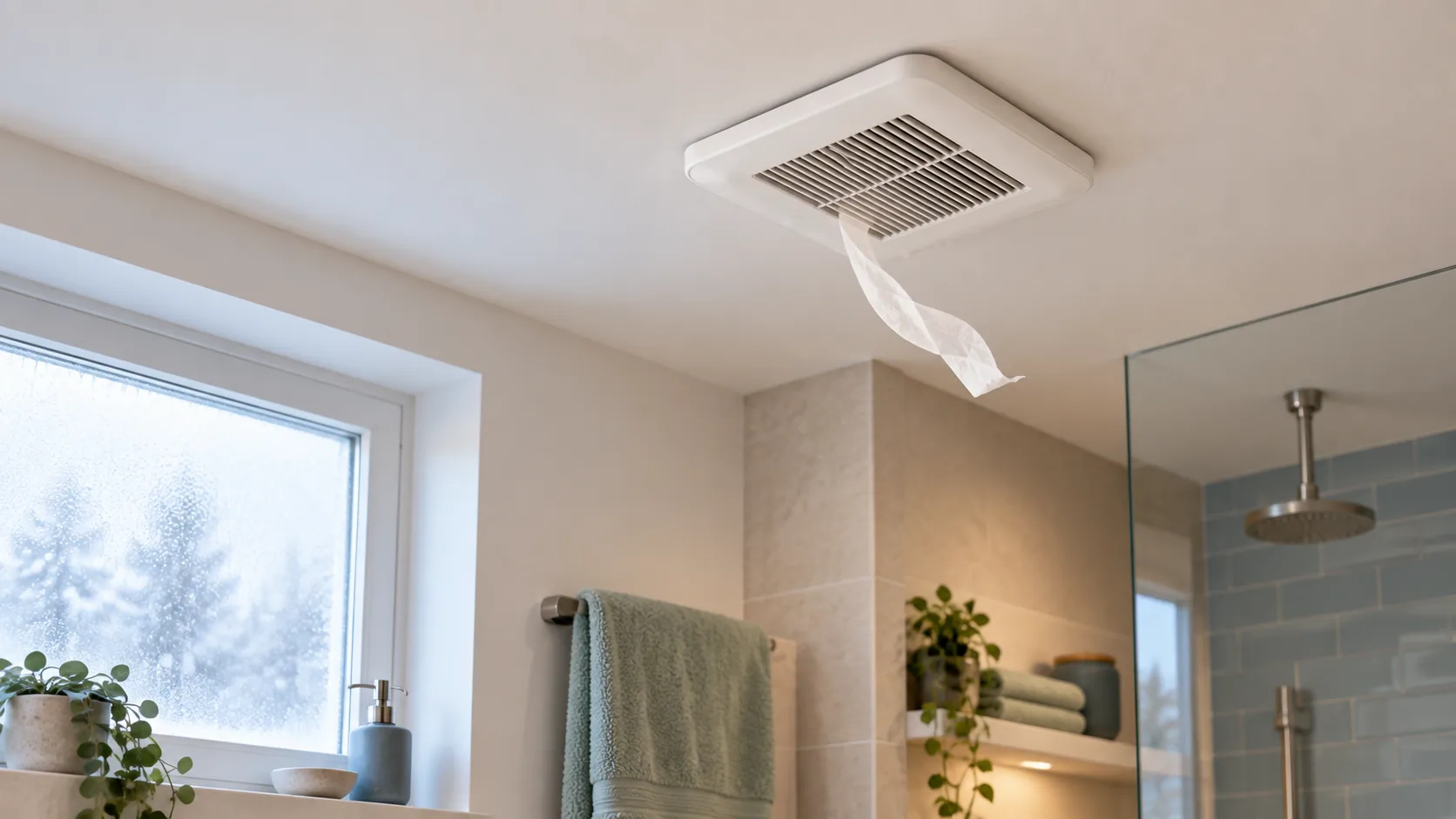
Cold air at the grille most often points to a damper or exterior-cap flap that is missing, stuck, damaged or held open, but air can also leak around an unsealed fan housing or duct connection. Wind can make an intermittent draft more noticeable. Confirm where the air is entering, observe the system from safe locations and have inaccessible duct, damper or cap faults repaired. Do not tape over or stuff the exhaust grille.
First, identify where the air is moving
Turn the fan off and stand on the floor beneath it. With a dry hand, compare the center of the grille with the ceiling edge around the grille. A draft through the grille points toward the exhaust path. A draft mainly around the trim points more toward gaps around the housing or ceiling opening. Repeat the observation once on a windy day and once in calmer weather if the problem is intermittent.
Do not use a candle, lighter, incense stick or other flame or smoke source near the grille. It adds an avoidable fire or indoor-air risk and is not needed to establish that a draft exists.
Use this safe check sequence
- Note when it happens. Record whether the draft appears only when the fan is off, only during strong wind, or all the time. Also note whether another exhaust appliance was running. Timing gives a technician more useful evidence than fan noise alone.
- Look for a gap at the ceiling. From floor level, inspect the visible edge around the fan grille. A dark or uneven gap does not prove the housing leaks, but it is a reason to have the fan-to-ceiling opening and duct connection checked. The U.S. Department of Energy’s Building America Solution Center recommends air-sealing around exhaust fan housings and sealing the exhaust duct connection with approved materials.
- Run the fan briefly. Listen for normal operation and feel whether air is being drawn at the grille. Motor sound is not proof that air reaches outdoors. If the grille is dusty, follow the site’s power-off bathroom fan cleaning guide before judging airflow.
- Observe an accessible exterior cap. If a wall cap is visible from the ground or through a normal window, ask a helper to switch the fan on and off while you watch. A movable flap should open for exhaust and return toward its closed position afterward. Never lean out of a window, climb a ladder or walk on a roof for this check.
- Stop at inaccessible components. The integral damper is often inside or just above the fan outlet, and a roof cap may be impossible to inspect safely. A qualified ventilation contractor, HVAC technician or electrician can inspect these parts while following the fan manufacturer’s instructions and local requirements.
What the pattern can mean
| What you observe | Likely area to inspect | Useful next step |
|---|---|---|
| Draft through the grille mainly during wind | Exterior cap or damper movement; cap exposure | Document wind direction and have the cap and damper checked from a safe access point. |
| Steady draft through the grille with the fan off | Damper or exterior flap not closing; open or disconnected path | Arrange inspection of the complete fan-to-outdoors route. |
| Draft mainly around the grille edge | Gap around the housing or duct connection | Have the opening and connection sealed with materials suitable for the assembly. |
| Fan runs but airflow seems weak | Dust, a closed or obstructed damper, restrictive ductwork or a blocked cap | Clean only accessible parts with power isolated, then request an airflow and duct inspection if performance remains weak. |
| Water is present at the grille | Condensation, roof entry, plumbing or another leak source | Treat this as a separate wet-electrical problem and use the bathroom fan dripping-water safety checklist. |
Why a damper matters
A backdraft damper is intended to let exhaust move outward while limiting reverse flow when the fan is off. Some fans have an integral damper near the housing; exterior wall or roof caps may also have a flap. The Building America Solution Center specifically calls for individual backdraft dampers where multiple fans connect to a shared common exhaust duct so air does not move backward from one branch to another.
A flap can fail to close because it is damaged, misaligned, obstructed or affected by installation details. Do not assume that adding a second damper is automatically the right fix: extra resistance can reduce airflow, and shared-duct arrangements require design review. Match any replacement to the fan and duct system rather than improvising.
Air can leak around the fan, not just through it
The ceiling opening and the connection between the fan housing and exhaust duct pass between indoor and sometimes unconditioned space. Gaps in those locations can leak air even when the duct damper closes correctly. Federal Building America guidance recommends sealing around the housing, sealing holes in the housing as appropriate, and sealing the duct-to-fan connection with approved metal tape or mastic. The correct material and method depend on the fan’s listing, ceiling assembly and local code.
This is also why a visible exterior cap does not settle the whole diagnosis. Use the separate guide to confirm that the bathroom fan has a continuous route outdoors; then have leaks, damaged duct sections and cap faults corrected as one system.
What not to do
- Do not block the grille. Tape, plastic and stuffed insulation disable moisture exhaust and may interfere with the fan.
- Do not reach through the grille with power available. Switch off the correct circuit before removing or cleaning parts, and stop if the circuit cannot be identified confidently.
- Do not spray lubricant or cleaner into the housing or duct. Use only maintenance methods allowed by the manufacturer.
- Do not disconnect a damper or alter a shared duct as a trial. That can move air and odors between spaces or reduce system performance.
- Do not access a roof or cramped attic for a casual check. Fall, heat, electrical and fragile-ceiling hazards belong to trained, equipped professionals.
When to call for help now
Stop using the fan and isolate power if water is entering the electrical housing, the fan smells hot or burnt, it sparks, it repeatedly trips a breaker, or the motor stalls. Keep clear of a wet fixture and use a qualified electrician or appropriate building professional. For a persistent dry draft without those warning signs, schedule a ventilation or HVAC inspection rather than sealing the exhaust opening.
Ask the professional to check the integral damper, exterior cap, duct joints, route, insulation where the duct crosses cold space, and air sealing around the housing. If the fan shares a duct, identify every connected branch. A useful completion check is simple: the fan exhausts outdoors, the flap moves as designed, the grille remains open, and the draft is no longer present with the fan off under comparable weather.
Sources and evidence boundaries
This guide applies building-science guidance to a homeowner-safe observation sequence. It does not diagnose a hidden duct or prescribe a universal damper, sealant or cap. Product instructions and local electrical, mechanical, fire and roofing requirements control the repair.
- U.S. Department of Energy, Building America Solution Center: Bathroom Exhaust Fans — outdoor termination, manufacturer-specified ducting and direct duct routing.
- U.S. Department of Energy, Building America Solution Center: Air Sealing Bathroom and Kitchen Exhaust Fans — sealing around housings, duct connections and exterior penetrations.
- U.S. Department of Energy, Building America Solution Center: Back-Draft Dampers at Shared Common Exhaust Duct — individual dampers for shared exhaust branches.
- Building Science Corporation: Top Ten Issues in Residential Ventilation Design — duct routing, insulation in cold spaces and backdraft-damper design considerations.